Unimodular matrices
unimodular.RdSystematically generates unimodular matrices; numerical verification of a function's unimodularness
unimodular(n)
unimodularity(n,o, FUN, ...)
Arguments
Details
Here, a ‘unimodular’ matrix is of size \(2\times 2\), with integer entries and a determinant of unity.
Value
Function unimodular() returns an array a of dimension
c(2,2,u) (where u is a complicated function of n).
Thus 3-slices of a (that is, a[,,i]) are unimodular.
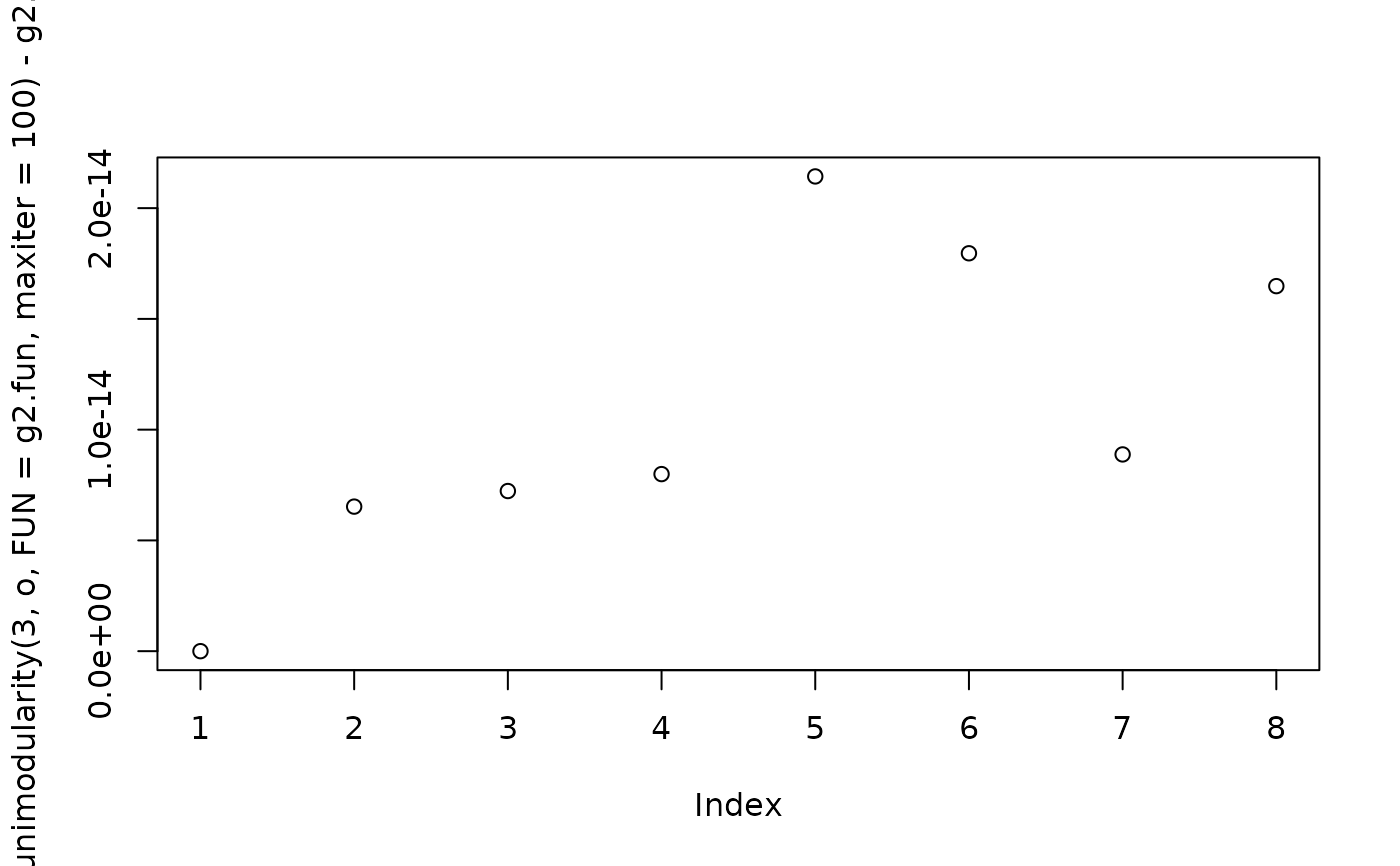
Function unimodularity() returns the result of applying
FUN() to the unimodular transformations of o. The
function returns a vector of length dim(unimodular(n))[3]; if
FUN() is unimodular and roundoff is neglected, all elements of
the vector should be identical.
Note
In function as.primitive(), a ‘unimodular’ may have
determinant minus one.
See also
Examples
unimodular(3)
#> , , 1
#>
#>      [,1] [,2]
#> [1,]    1    0
#> [2,]    0    1
#>
#> , , 2
#>
#>      [,1] [,2]
#> [1,]    1    1
#> [2,]    0    1
#>
#> , , 3
#>
#>      [,1] [,2]
#> [1,]    1    2
#> [2,]    0    1
#>
#> , , 4
#>
#>      [,1] [,2]
#> [1,]    2    1
#> [2,]    1    1
#>
#> , , 5
#>
#>      [,1] [,2]
#> [1,]    1    3
#> [2,]    0    1
#>
#> , , 6
#>
#>      [,1] [,2]
#> [1,]    3    2
#> [2,]    1    1
#>
#> , , 7
#>
#>      [,1] [,2]
#> [1,]    2    3
#> [2,]    1    2
#>
#> , , 8
#>
#>      [,1] [,2]
#> [1,]    3    1
#> [2,]    2    1
#>

o <- c(1,1i)
plot(abs(unimodularity(3,o,FUN=g2.fun,maxiter=100)-g2.fun(o)))